
- June 24, 2026
- Posted by: admin
- Category: Uncategorized
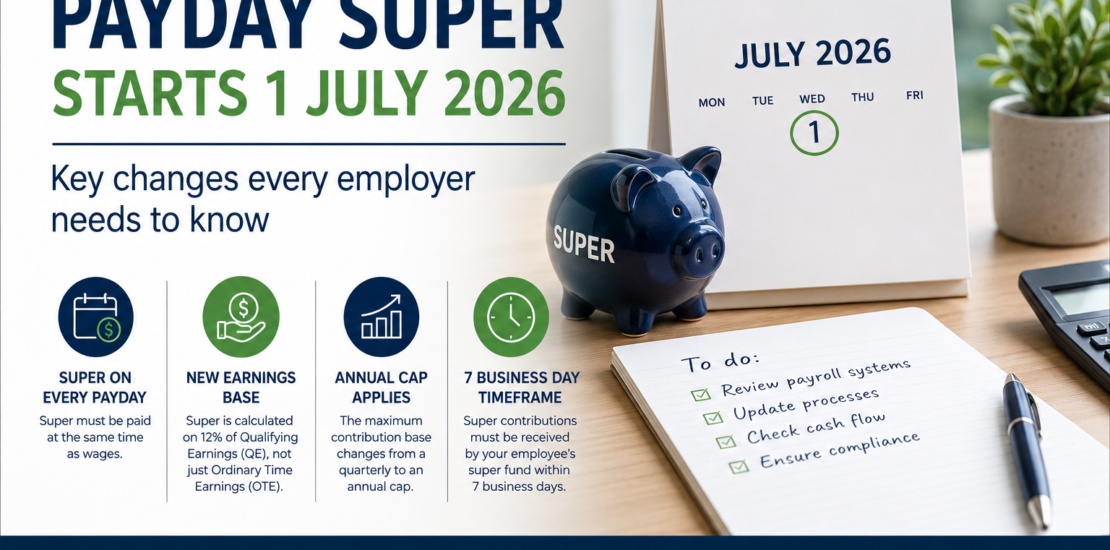
Australian employers are now required to pay Super Guarantee (SG) contributions at the same time employees are paid their wages under the new Payday Super reforms, which commenced on 1 July 2026. This replaces the previous quarterly super guarantee payment system.
What’s Changed?
- Super must be paid on every payday rather than quarterly.
- Contributions generally need to reach employees’ super funds within 7 business days of payday.
- Employers must calculate super based on each pay cycle and report through enhanced payroll reporting systems.
Why the Reform Matters
The Federal Government and ATO introduced Payday Super to reduce unpaid super, improve transparency, and help employees grow their retirement savings through earlier and more frequent contributions. Treasury estimates younger workers could accumulate thousands of dollars more in retirement savings due to the power of compounding.
New Earnings Base – Qualifying Earnings (QE)
A significant change is the introduction of Qualifying Earnings (QE) as the basis for calculating super.
Previously, SG was calculated on Ordinary Time Earnings (OTE). From 1 July 2026, employers must calculate SG at of Qualifying Earnings, which generally includes:
- Ordinary earnings
- Commissions
- Certain salary sacrifice amounts
- Other payments captured under the new QE framework
This change aims to simplify super calculations and improve consistency across payroll systems.
ATO’s Small Business Super Clearing House (SBSCH)
ATO’s Small Business Super Clearing House (SBSCH) is shutting down permanently on 30/06/2026. From 01/07/2026, super payment has to be made thru alternate sources (Payroll systems etc)
What Employers Should Do Now
- Review payroll and accounting systems.
- Confirm payroll software supports Payday Super reporting.
- Check cash-flow planning to accommodate more frequent super payments.
- Ensure internal payroll processes meet the new 7-business-day requirement.
ATO Reminder
The ATO encourages all employers to prepare early and ensure compliance, as late or unpaid super may attract penalties and increased regulatory scrutiny under the new regime.
Need Help with registration?
Please get in touch.